

Article: Wash Mitt vs. Sponge: Which Is Better for Washing Your Car?
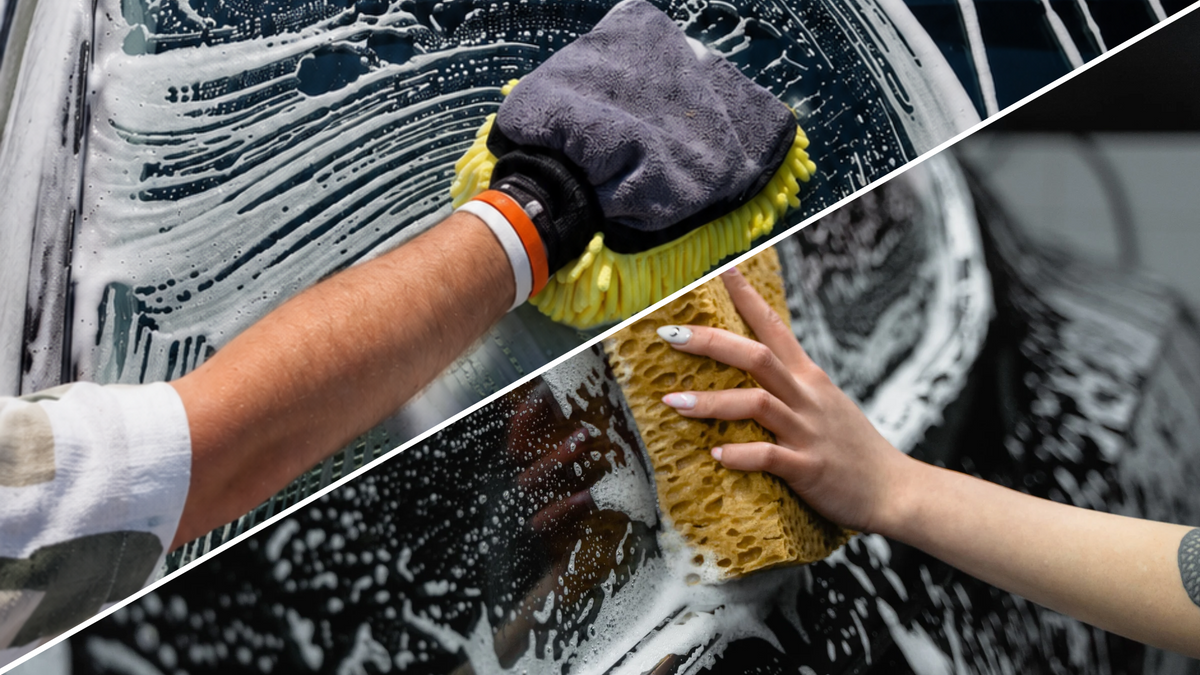
Wash Mitt vs. Sponge: Which Is Better for Washing Your Car?
Washing a car might seem like one of the simplest maintenance tasks at first glance. All you need is water, car shampoo, and something to spread the cleaning solution across the bodywork. For a long time, the traditional sponge was the obvious choice for that last step. It's inexpensive, widely available, and feels soft enough that there's little reason to worry about running it across your car's paintwork.
The problem is that the sponge isn't the only thing coming into contact with the paint during a wash. Between the sponge and the car's surface, there are constantly particles of dust, sand, dirt, and other contaminants being lifted from the bodywork. At that point, the important question is no longer just how soft the material in your hand feels, but what happens to those dirt particles as you continue washing.
This is where the difference between a traditional sponge and a long-fiber wash mitt becomes clear. Both can distribute car shampoo and lift dirt from the surface, but the way their materials interact with particles on the paintwork is different. And if your goal isn't simply to have a car that looks clean after washing, but also to preserve its finish in the best possible condition over time, this difference is worth understanding.

Why Contact with the Paintwork Is the Most Delicate Part of Washing Your Car
A large portion of visible dirt can be removed before you even touch the car. A thorough pre-rinse and, when necessary, the use of a pre-wash solution can remove dust, mud, and contaminants that aren't firmly bonded to the surface. However, even after this step, a thin film of dirt usually remains, requiring physical contact to remove it completely.
This is where the greatest risk of causing micro-scratches during a car wash comes into play.
A car's paintwork is protected by a transparent clear coat, and the fine circular scratches we notice under bright light are most often found within this layer. Commonly known as swirl marks, these imperfections don't necessarily result from a single major incident. More often, they develop gradually through repeated contact between the paint surface and abrasive particles.
Imagine a car that has been driven in rainy conditions for several days. Its doors and lower body panels are covered with a mixture of dried water residue, road dust, and extremely fine sand particles. If one of these particles becomes trapped between your washing tool and the clear coat, then gets dragged across the surface for several inches, the effect can be similar to rubbing an extremely fine abrasive against the paintwork.
This doesn't mean you'll immediately notice a large scratch. In fact, that's precisely the problem. These imperfections accumulate gradually and become particularly noticeable in direct sunlight or under strong artificial lighting, when a finish that once appeared flawless begins to reveal those fine circular marks and hairline scratches.
That's why proper car washing should accomplish two things at the same time: effectively lift dirt from the surface while minimizing the movement of abrasive particles across the paintwork.
What Happens When You Wash Your Car with a Traditional Sponge
A traditional car wash sponge typically has a relatively uniform surface. It feels soft to the touch and can hold a considerable amount of water and car shampoo, which explains why it has become such a popular choice for washing vehicles.
The problem isn't necessarily the sponge itself, but rather what can happen to dirt particles trapped between its surface and the car's bodywork.
As you move the sponge across the paintwork, the dirt particles being lifted have to go somewhere. With a relatively flat surface, some of these particles may remain trapped in the contact area between the sponge and the clear coat. As your hand continues moving, those particles can be dragged along with the sponge.
When dealing with extremely fine dust, the consequences may be minimal. However, if a grain of sand or a harder contaminant gets caught between the two surfaces, the risk of leaving scratches increases.
The situation becomes even more problematic when the same side of the sponge is used across a large area without being rinsed thoroughly. Dirt collected from the lower section of a door can easily be transferred to other body panels. As a result, what should be a cleaning tool can end up carrying contaminants from one area of the vehicle to another.
This is one of the main reasons why traditional sponges have developed a negative reputation in the car detailing industry. It's not that every time a sponge touches your car, it will instantly scratch the paint. Rather, its design isn't ideal for managing the dirt and contaminants lifted from the surface during washing.

Why a Car Wash Mitt Works Differently
A long-fiber car wash mitt approaches the same problem in a different way. Instead of providing an almost flat contact surface, it features a fiber structure that allows dirt particles to move between the fibers as they are lifted from the bodywork.
This is one of the key features of a wash mitt like CleanPro. The fibers aren't simply designed to make the mitt feel soft and comfortable to the touch. They also create space for contaminants to be lifted away from the paintwork, reducing the amount of dirt that remains directly between the washing tool and the car's surface.
This doesn't mean that dirt particles disappear or that using a wash mitt makes micro-scratches impossible. Contaminants are still held within the mitt, which is exactly why it needs to be rinsed frequently throughout the washing process. The advantage is that its fiber structure allows dirt particles to move away from the immediate contact area more easily.
There's also a practical benefit. Because the mitt fits over your hand, you have greater control over pressure and movement. You don't need to grip or squeeze the washing tool to hold it in place, making it easier to follow the contours of the bodywork with controlled movements and minimal pressure.
During a proper car wash, you shouldn't even feel like you're scrubbing the paintwork. The mitt should glide smoothly over the layer of water and car shampoo, allowing the cleaning solution and the mitt's fibers to do most of the work.
Even a High-Quality Wash Mitt Can't Make Up for Poor Washing Technique
It would be easy to say that simply replacing a sponge with a wash mitt solves the problem of micro-scratches, but the reality is more complicated. You can use the best wash mitt available and still damage your car's paintwork if the rest of your washing process is incorrect.
If you start washing a car that's covered in dried mud without rinsing it first, those dirt particles have to go somewhere as you move the mitt across the surface. And if you don't rinse the mitt regularly, continuing to wash the entire car with dirt trapped in its fibers, the benefits of its long-fiber design become increasingly less effective.
That's why pre-rinsing is essential. The more dirt you remove before making physical contact with the paintwork, the fewer particles remain that could become trapped between the wash mitt and the clear coat.
The order in which you wash your car is equally important. The lower sections of the doors, side skirts, and areas behind the wheels are generally much more contaminated than the roof or upper body panels. If you start with the dirtiest areas and then use the same mitt on the rest of the vehicle, you risk spreading the very contaminants you're trying to avoid.
A better approach is to start at the top of the vehicle, where dirt accumulation is usually lighter, and gradually work your way down to the lower sections. The wash mitt should be rinsed regularly, not just when it becomes visibly dirty.

More Pressure Doesn't Mean a Cleaner Car
Another common habit associated with washing a car using a sponge is the tendency to apply more pressure when a stain or mark doesn't come off immediately. It seems intuitive: if the dirt won't budge, scrub harder. However, when it comes to automotive paintwork, this isn't always the right approach.
If contamination remains on the surface after a normal wash, it may not simply be dirt that requires more force to remove. It could be tar, tree sap, insect residue, iron contamination, or another type of stubborn deposit that requires specialized cleaning products and techniques.
Pressing harder with a sponge or wash mitt doesn't necessarily make the cleaning product more effective. Instead, it increases the pressure exerted by any particles trapped between the washing tool and the clear coat.
A good wash mitt should be allowed to glide smoothly across the surface. If you find yourself needing to scrub aggressively in a particular spot, it's better to stop and identify the type of contamination rather than continue rubbing.
This is one of the reasons why modern car detailing places so much emphasis on minimizing unnecessary contact with the paintwork. The goal isn't to clean your car by applying as much force as possible, but to use water, cleaning products, and washing accessories effectively so that the least amount of physical pressure is needed.
How Smoothly Your Washing Tool Glides Across the Surface Also Matters
Car shampoo isn't just there to create foam. A properly formulated shampoo also helps lubricate the surface during washing, allowing your washing tool to glide more smoothly across the paintwork.
The difference is easy to feel. When you move an almost dry washing tool across a surface, there's significantly more resistance than when there's enough water and cleaning solution between the two. Greater resistance also means more force being transferred to any particles trapped in the contact area.
A wash mitt that can hold a sufficient amount of water and shampoo helps maintain this lubricating layer as you work. However, it's important not to overestimate the role of the mitt itself. The wash mitt, car shampoo, and washing technique all work together as part of the same process.
If your wash bucket is full of dirty water, your mitt isn't being rinsed regularly, and the car hasn't been properly pre-rinsed, simply switching from a traditional sponge to a microfiber or chenille wash mitt won't automatically make the washing process safe for your paintwork.

Why the Lower Sections of Your Car Deserve Special Attention
If there's one area where the difference between a careful car wash and a rushed one becomes particularly obvious, it's the lower sections of the bodywork.
After several days of rainy weather, a quick look at the side skirts is enough to see just how much contamination can build up in these areas. Water sprayed up by the tires carries dirt and debris from the road, and some of these particles remain on the vehicle even after the water has evaporated.
When you move your wash mitt across these areas, it can pick up significantly more dirt and contaminants than it would when washing the roof. That's why it's not a good idea to immediately continue washing other body panels with the same side of the mitt without thoroughly rinsing it first.
Some car detailing enthusiasts take this a step further by using separate washing tools for heavily contaminated areas. You don't need to turn every car wash into a professional detailing session, but the principle behind this practice makes perfect sense: you want to avoid transferring dirt from the most contaminated parts of your vehicle to its cleaner surfaces.
The same reasoning explains why tools used to clean your wheels should never be used on the bodywork afterward. Brake dust and the contaminants that accumulate on your wheels are exactly the kinds of particles you don't want trapped in a wash mitt that you're about to use on your car's paintwork.
Your Wash Mitt Also Needs to Be Cleaned After Every Wash
A wash mitt is effective precisely because its fibers can capture and hold dirt and contaminants. However, this also means it needs to be cleaned properly after each use. If the mitt is left to dry while still full of dirt and then reused during your next car wash, some of the particles trapped in its fibers can end up right back on your car's paintwork.
After washing your car, the mitt should be thoroughly rinsed and cleaned to ensure its fibers remain free from contaminants and residue. Before using it again, it's worth inspecting it visually and even checking it by hand. A tiny piece of grit trapped deep within the material can be enough to turn a washing tool designed to protect your paintwork into a potential source of scratches.
The same principle applies to all microfiber products used on your car. Drying towels, interior cleaning cloths, and washing accessories all need proper care and maintenance to preserve their performance and effectiveness over time.
Does a Sponge Scratch Your Car While a Wash Mitt Doesn't?
That statement is too simplistic to accurately describe what happens during the car washing process.
It's not accurate to say that every sponge will automatically scratch your car or that using a wash mitt completely eliminates the risk. Micro-scratches are influenced by several factors, including the amount and type of contamination, the pressure applied, surface lubrication, how frequently the washing tool is rinsed, and your overall washing technique.
The key difference is that the structure of a long-fiber wash mitt is better suited to managing dirt and contaminants lifted from the paintwork. Its fibers provide space for particles to move away from the immediate contact area, rather than remaining concentrated on a relatively flat surface directly between the washing tool and the clear coat.
From this perspective, a wash mitt isn't a miracle solution. It's simply a more suitable tool for a washing process designed to minimize abrasive contact with the paintwork.
And if you've recently invested time in paint correction or had a ceramic coating applied to your vehicle, choosing the right washing method becomes even more important. After all, it would be counterproductive to spend time removing swirl marks and achieving a flawless, glossy finish, only to gradually reintroduce those same imperfections through aggressive washing techniques.

Wash Mitt or Sponge? The Difference Becomes More Noticeable Over Time
After a single wash, a car cleaned with a traditional sponge and one washed with a microfiber wash mitt may look almost identical. Both can appear clean, glossy, and free from visible dirt.
The real difference isn't necessarily something you'll notice after the first wash, but rather after dozens of washes.
Every time a washing tool comes into contact with your car's paintwork, there's a potential risk of causing micro-scratches. How you wash your car determines whether you minimize or increase that risk. Proper pre-rinsing, sufficient lubrication, gentle pressure, frequent rinsing of your washing tool, and using a wash mitt with suitable fibers are all part of the same approach to safer car washing.
A wash mitt like CleanPro makes sense precisely in this context. Not because simply using it makes your paintwork scratch-proof, but because its fiber structure is better suited to capturing dirt during washing and reducing the amount of contamination that remains directly in contact with the paint surface.
Ultimately, the goal of a proper car wash isn't just to remove the dirt you can see on your vehicle at that moment. It's to do so without gradually introducing the imperfections that might become visible in direct sunlight a few months down the road.
A sponge can remove dirt. A wash mitt can do the same. The difference lies in how each one handles the particles lifted from the surface during washing. And when dealing with something as delicate as your car's clear coat, that seemingly small detail can make a much bigger difference than you might think.


Leave a comment
This site is protected by hCaptcha and the hCaptcha Privacy Policy and Terms of Service apply.